Businesses today have access to hundreds of ready-made software platforms for accounting, CRM, HR, inventory, project management, communication, and other business functions.
At the same time, many organizations eventually reach a point where generic software no longer fits their processes.
This raises an important question:
Should you buy ready-made software or invest in a custom software solution?
There is no universal answer. The right choice depends on your business requirements, budget, operational complexity, integration needs, and long-term growth plans.
What Is Ready-Made Software?
Ready-made software is a pre-built application designed for a broad range of businesses.
Examples include:
CRM platforms
Accounting software
HR systems
Inventory management platforms
Project management tools
E-commerce platforms
Communication tools
You typically subscribe to the platform, configure the available settings, and start using it.
Advantages of Ready-Made Software
Faster Implementation
Most ready-made solutions can be deployed much faster than a custom application.
Lower Initial Cost
Subscription-based software can be more affordable initially, particularly for small businesses.
Established Features
Popular platforms often provide a large collection of tested features.
Regular Updates
The software provider generally manages updates, maintenance, security patches, and infrastructure.
Technical Support
Most established platforms provide documentation and customer support.
What Is Custom Software Development?
Custom software is designed and developed specifically for your organization's requirements.
Instead of adapting your business processes to an existing platform, the software is built around your workflows.
A custom system could include:
CRM
ERP
Inventory management
Customer portals
Mobile applications
Business dashboards
Workflow automation
Booking systems
Fleet management
Industry-specific platforms
For example, a business may have a unique process such as:
Customer Order → Quality Check → Approval → Production → Packaging → Dispatch
If existing software cannot handle this workflow effectively, a custom application can be designed around it.
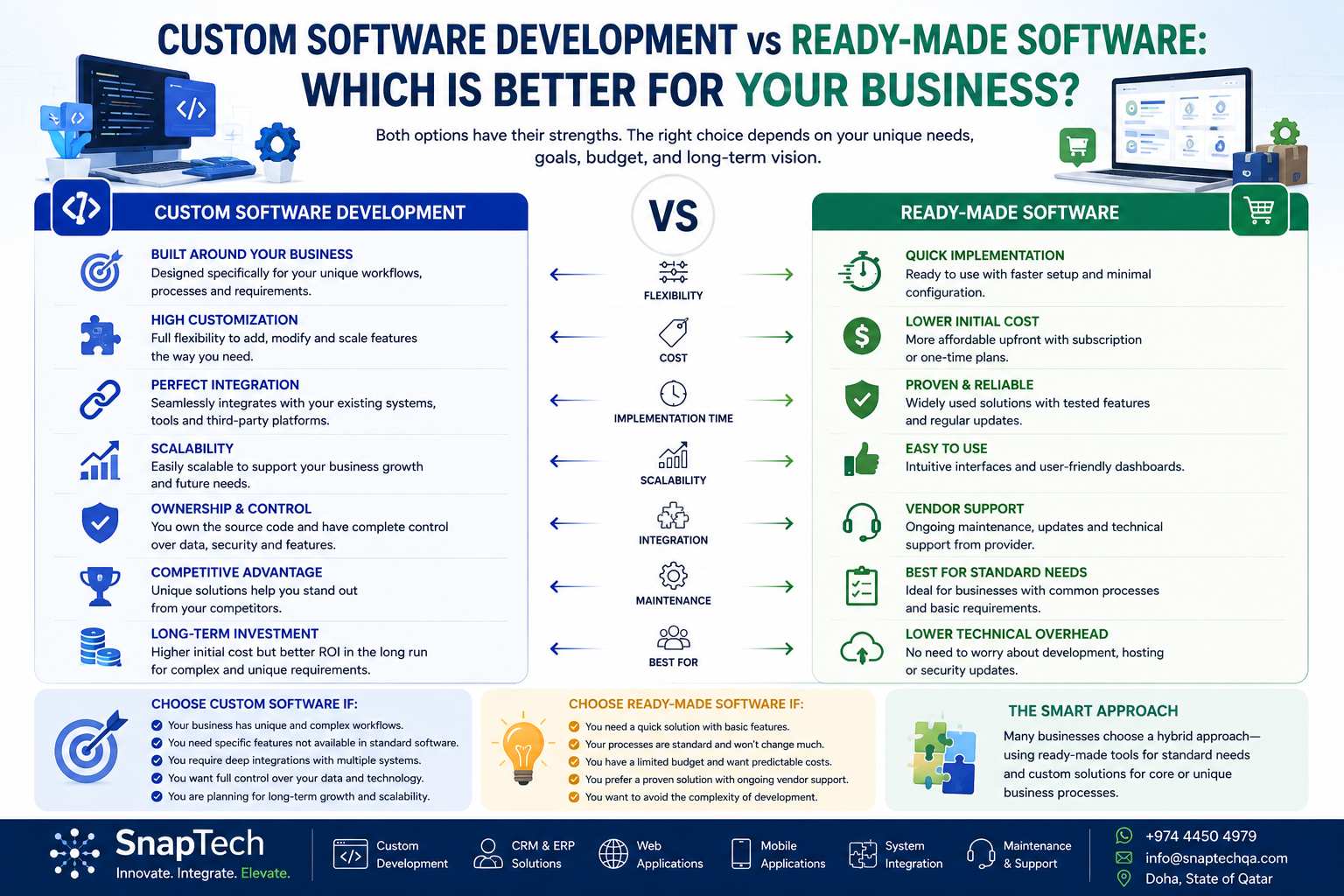
Custom vs Ready-Made Software
| Factor | Ready-Made Software | Custom Software |
|---|---|---|
| Initial cost | Usually lower | Usually higher |
| Deployment | Faster | Takes longer |
| Customization | Limited to available features | Highly customizable |
| Business workflows | Adapt to software | Software adapts to business |
| Integrations | Available integrations | Custom integrations possible |
| Scalability | Depends on provider | Designed around your growth |
| Ownership | Usually subscription/licensing | Greater control over solution |
| Updates | Provider-managed | Custom development/maintenance |
| Competitive advantage | Limited | Can create unique capabilities |
| Long-term flexibility | Depends on vendor | High |
When Should You Choose Ready-Made Software?
Ready-made software can be a good choice when your business requirements are relatively standard.
Consider ready-made software if:
You need a solution quickly.
Your processes are fairly standard.
Your budget is limited.
You don't require extensive customization.
The software already provides the features you need.
You don't need complex integrations.
You prefer predictable subscription costs.
Example
A small consulting company may simply need:
Contacts → Leads → Follow-ups → Sales Pipeline → Reports
A ready-made CRM could provide all of these capabilities without requiring custom development.
When Should You Choose Custom Software?
Custom development becomes more attractive when your business has unique or complex requirements.
Consider custom software if:
Your workflows are unique.
Existing software requires too many workarounds.
Multiple systems need to communicate with each other.
You need industry-specific functionality.
You have complex approval processes.
You need complete control over workflows.
Your business is scaling rapidly.
You want to create a unique digital product.
Existing software creates significant operational inefficiencies.
The Hidden Cost of Ready-Made Software
Ready-made software can appear cheaper initially, but businesses should consider the total cost of ownership.
For example:
Monthly subscription
Additional users
Premium features
Third-party integrations
Customization
Data migration
Multiple software subscriptions
Over time, these costs can become significant.
A business may eventually end up using five or six different applications simply because no single platform fits all its requirements.
The Hidden Cost of Custom Software
Custom development also has costs that businesses need to consider.
These can include:
Initial development
UI/UX design
Testing
Infrastructure
Security
Maintenance
Updates
Technical support
Future feature development
Custom software therefore requires a long-term technology strategy rather than simply a one-time development budget.
Integration Can Change the Decision
One of the most important factors is integration.
Suppose a business currently uses:
Website
CRM
Accounting Software
Inventory System
Payment Gateway
HR Software
If these systems don't communicate properly, employees may have to manually transfer information between platforms.
A custom integration layer can connect these systems.
For example:
Website → CRM → ERP → Inventory → Accounting
This can sometimes be a better solution than replacing every existing system.
Custom Software Does Not Always Mean Building Everything From Scratch
This is an important distinction.
Businesses don't necessarily need to develop an entire software ecosystem from zero.
A hybrid approach can often be more practical.
For example:
Ready-Made Accounting Software
Custom CRM
Custom Inventory System
API Integration
Custom Management Dashboard
This provides customization where it matters while continuing to use established platforms for standardized functions.
Which Option Is Better for a Business in Qatar?
For businesses in Qatar, the decision should consider factors such as:
Business size
Number of employees
Number of locations
Industry
Existing software
Integration requirements
Data requirements
Security requirements
Future expansion
Budget
A small business with straightforward requirements may benefit from ready-made software.
A growing organization with multiple departments, branches, workflows, and systems may benefit more from customized solutions or a hybrid architecture.
A Simple Decision Framework
Choose Ready-Made Software If:
Your business can adapt to the software.
You need standard functionality, fast implementation, and lower initial costs.
Choose Custom Software If:
The software needs to adapt to your business.
You have unique workflows, complex integrations, specialized requirements, or a need for greater control.
Choose a Hybrid Approach If:
Some processes are standard and others are unique.
Use established software for standard functions and build custom solutions where differentiation or integration is important.
How SnapTech Can Help
SnapTech develops customized software solutions for businesses in Qatar.
Our approach starts by understanding the business process rather than immediately selecting a technology.
We can help with:
Business process analysis
Custom CRM development
ERP development
Web applications
Mobile applications
Workflow automation
API development
System integration
Business dashboards
E-commerce solutions
Database development
Cloud deployment
Software maintenance and support
We can also help businesses determine whether custom development, ready-made software, or a hybrid approach makes the most sense for their requirements.
The Right Software Is the One That Solves Your Business Problem
There is no simple rule that says custom software is always better or ready-made software is always cheaper.
The right decision depends on what your business actually needs.
If your processes are standard and an existing platform solves your requirements effectively, ready-made software may be the smarter choice.
If your processes are unique, your systems need complex integration, or existing platforms are restricting your growth, custom software may provide greater long-term value.
And in many cases, the best solution is somewhere in between.
The goal isn't to build more software. The goal is to build better business processes.
Build Software Around Your Business
Talk to SnapTech about your software requirements and discover whether a custom, ready-made, or hybrid solution is right for your organization.
SnapTech — Innovate. Integrate. Elevate.
WhatsApp: +974 4450 4979
Email: info@snaptechqa.com
Location: Doha, State of Qatar