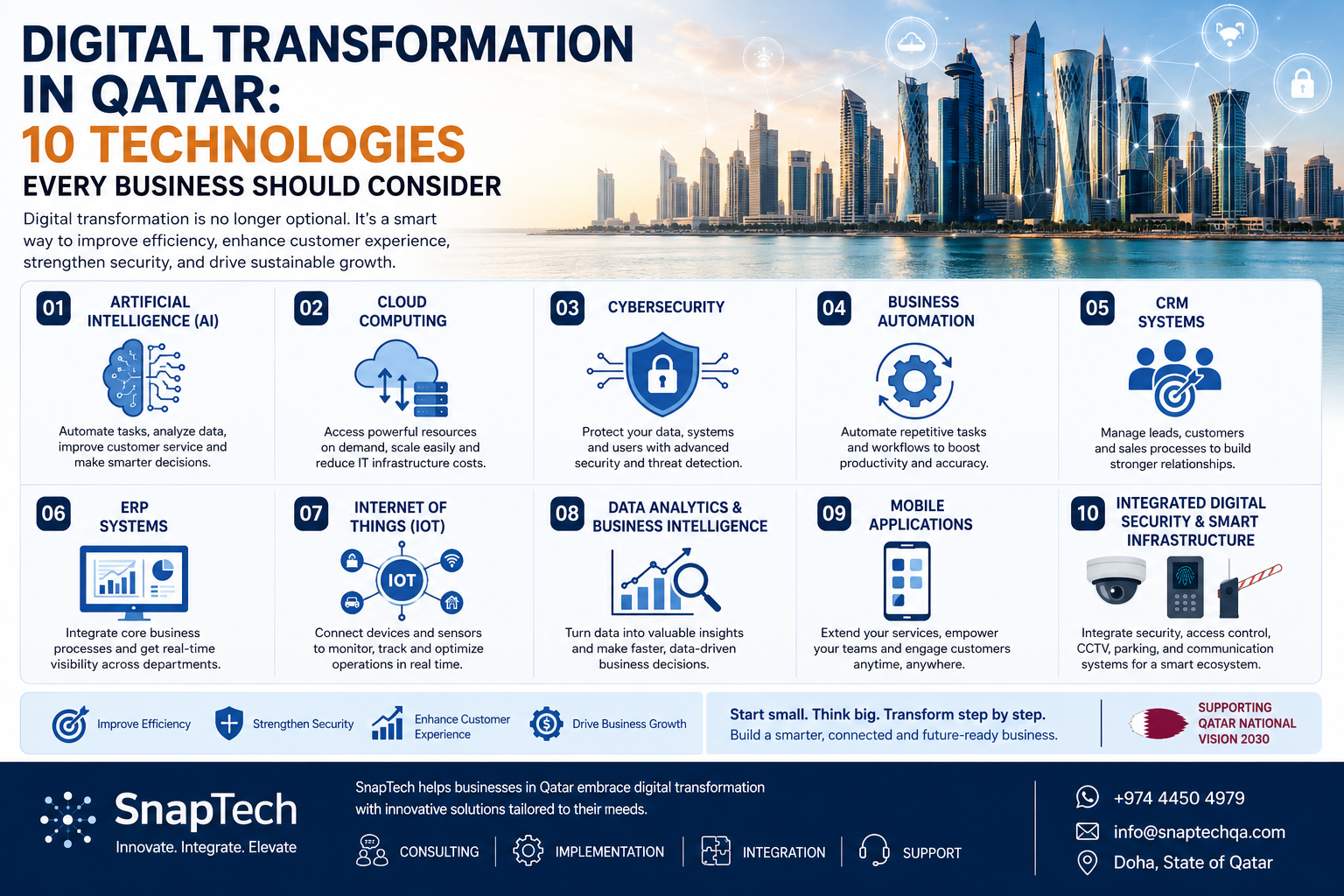
Digital transformation is no longer limited to large enterprises or technology companies. Businesses across Qatar are increasingly adopting digital technologies to improve efficiency, reduce operational costs, strengthen security, and deliver better customer experiences.
Qatar's Digital Agenda 2030 provides a national roadmap for digital transformation, with strategic pillars covering digital infrastructure, digital technologies, innovation, the digital economy, government, and society. The agenda is intended to accelerate digital adoption and support a competitive, technology-driven economy. (Ministry of Communications)
For businesses, this creates an opportunity to look beyond simply "going digital" and focus on technologies that can deliver measurable business value.
Here are 10 technologies businesses in Qatar should consider.
1. Artificial Intelligence
Artificial Intelligence (AI) is becoming one of the most important technologies for modern businesses.
AI can help organizations automate tasks, analyze large amounts of information, improve customer service, and support better decision-making.
Business applications include:
AI-powered customer support
Document processing
Data analysis
Predictive analytics
Intelligent search
Recommendation systems
Fraud and anomaly detection
Automated content generation
AI-assisted business processes
Qatar's digital strategy places significant emphasis on emerging technologies including AI, and MCIT has also been supporting SMEs in exploring practical AI use cases for productivity, data management, and automation. (Ministry of Communications)
2. Cloud Computing
Cloud computing allows businesses to access applications, infrastructure, storage, and computing resources without having to maintain all infrastructure themselves.
Businesses can use cloud platforms for:
Website hosting
Business applications
Databases
Backup
File storage
Disaster recovery
Analytics
Application development
Cloud infrastructure can also make it easier to scale systems as business requirements change.
For businesses operating multiple locations, cloud-based systems can provide centralized access to applications and information.
3. Cybersecurity
As businesses become more dependent on digital systems, cybersecurity becomes increasingly important.
A digital transformation strategy should therefore include security from the beginning rather than treating it as an afterthought.
Businesses should consider:
Network security
Endpoint protection
Identity and access management
Multi-factor authentication
Data encryption
Security monitoring
Backup and disaster recovery
Security awareness
Vulnerability management
A strong security strategy helps protect business data, customer information, applications, and infrastructure.
4. Business Automation
Many organizations still rely on manual processes for repetitive tasks.
Digital automation can convert these processes into structured workflows.
For example:
Customer enquiry
→ Lead creation
→ Employee assignment
→ Follow-up notification
→ Quotation
→ Approval
→ Customer notification
Instead of employees manually moving information between systems, automation can handle much of the workflow.
Common automation opportunities:
Invoice processing
Employee onboarding
Purchase approvals
Customer follow-ups
Notifications
Document processing
Inventory alerts
Reporting
Data synchronization
This can help businesses improve productivity while reducing repetitive work and errors.
5. CRM Systems
Customer Relationship Management (CRM) systems help businesses organize customer information and sales activities.
A CRM can centralize:
Leads
Customers
Sales opportunities
Follow-ups
Communications
Tasks
Quotations
Marketing campaigns
Customer support
Sales analytics
For businesses in sectors such as real estate, hospitality, professional services, education, retail, and B2B sales, CRM can provide greater visibility into the customer journey.
6. ERP Systems
While CRM focuses primarily on customers and sales, ERP systems connect broader business operations.
An ERP can bring together:
Finance
Accounting
Inventory
Purchasing
Sales
HR
Payroll
Manufacturing
Projects
Operations
For example:
Sales Order
→ Inventory
→ Purchase
→ Warehouse
→ Delivery
→ Invoice
→ Accounting
Connecting these processes can reduce duplicate data entry and provide management with a more complete view of business performance.
7. Internet of Things (IoT)
The Internet of Things connects physical devices and sensors to digital systems.
For businesses, IoT can enable real-time monitoring of equipment, vehicles, buildings, and other assets.
Examples include:
Fleet tracking
Smart parking
Building monitoring
Equipment monitoring
Environmental sensors
Energy monitoring
Asset tracking
Smart security systems
IoT becomes particularly valuable when connected to analytics and automation.
For example:
Sensor → Data → Analytics → Alert → Automated Action
This can turn physical infrastructure into an intelligent, connected system.
8. Data Analytics & Business Intelligence
Businesses generate large amounts of data through sales, customers, employees, operations, websites, and other systems.
The challenge is turning that data into useful information.
Business intelligence platforms can help management monitor:
Revenue
Sales performance
Customer acquisition
Inventory
Operational costs
Employee productivity
Website performance
Business KPIs
Instead of relying entirely on spreadsheets and manually prepared reports, businesses can use centralized dashboards to make faster, data-driven decisions.
9. Mobile Applications
Mobile applications can extend business services beyond traditional websites and desktop systems.
Businesses can develop applications for:
Customers
Employees
Sales teams
Field workers
Delivery teams
Management
Partners
For example, a field-service company could provide employees with a mobile application to receive jobs, navigate to customers, upload documents, capture photographs, and update job status in real time.
Mobile applications can also be integrated with CRM, ERP, payment systems, GPS, and other business platforms.
10. Integrated Digital Security & Smart Infrastructure
Digital transformation is not limited to software.
Physical security and infrastructure can also become part of an organization's digital ecosystem.
Modern businesses can integrate:
CCTV
Access control
Biometric attendance
Visitor management
Parking management
Fleet management
IP telephony
Networking
Smart locks
Video analytics
For example:
Access Control + CCTV + Visitor Management
can create a connected security environment where organizations can manage authorized users, visitors, entry events, and surveillance from integrated systems.
How Should a Qatar Business Start Its Digital Transformation?
One of the biggest mistakes businesses make is trying to implement too many technologies at once.
Digital transformation should begin with business problems, not technology.
Start by identifying:
1. What is slowing the business down?
Are employees spending too much time on manual tasks?
2. Where is data being duplicated?
Are different departments maintaining separate spreadsheets or systems?
3. Where are customers experiencing friction?
Are enquiries, bookings, support requests, or orders being handled manually?
4. What security gaps exist?
Are access, surveillance, network, or data security systems disconnected?
5. What information does management need?
Which KPIs and reports are currently difficult to obtain?
Once these questions are answered, businesses can determine which technologies will provide the greatest return.
Digital Transformation Does Not Mean Replacing Everything
Businesses don't necessarily need to replace their existing technology infrastructure.
In many cases, the better approach is integration.
For example:
Existing Website
↓
CRM
↓
ERP
↓
Inventory
↓
Finance
↓
Analytics
↓
Management Dashboard
Additional technologies such as automation, AI, IoT, CCTV, and mobile applications can then be integrated into the wider ecosystem.
This approach can allow businesses to modernize gradually rather than undertaking a complete technology replacement.
Why Digital Transformation Matters in Qatar
Qatar's Digital Agenda 2030 identifies digital infrastructure, digital technologies, innovation, and the digital economy as key components of the country's transformation strategy. (Ministry of Communications)
The country's focus is not limited to government services. MCIT has also been actively supporting businesses and SMEs through initiatives designed to accelerate digital technology adoption. In July 2026, the SMEs Go Digital "Connect" initiative brought together more than 195 SMEs and more than 20 digital solution providers to support technology adoption and digital transformation. (Ministry of Communications)
For businesses, this means digital transformation should increasingly be viewed as a business strategy, rather than simply an IT project.
How SnapTech Can Help
SnapTech provides technology and digital transformation solutions for businesses in Qatar.
Our capabilities cover both software and physical technology infrastructure, allowing businesses to build connected digital environments.
Our solutions include:
Digital Automation
CRM Development
ERP Development
Website Development
Mobile Application Development
CCTV & Surveillance
Access Control
Networking Solutions
Fleet Management
Parking Management
Visitor Management
Time Attendance
IP Telephony
Customized Software Solutions
We can help businesses assess their current environment, identify opportunities for improvement, integrate existing systems, and implement new technology according to their operational requirements.
Start With One Business Problem
Digital transformation doesn't have to happen overnight.
A business could start by automating one repetitive process, implementing a CRM, upgrading its security infrastructure, moving an application to the cloud, or creating a centralized management dashboard.
The objective should be simple:
Use technology to make the business more efficient, secure, connected, and scalable.
Ready to Start Your Digital Transformation?
Talk to SnapTech about building a technology roadmap for your business in Qatar.
SnapTech — Innovate. Integrate. Elevate.
WhatsApp: +974 4450 4979
Email: info@snaptechqa.com
Location: Doha, State of Qatar